
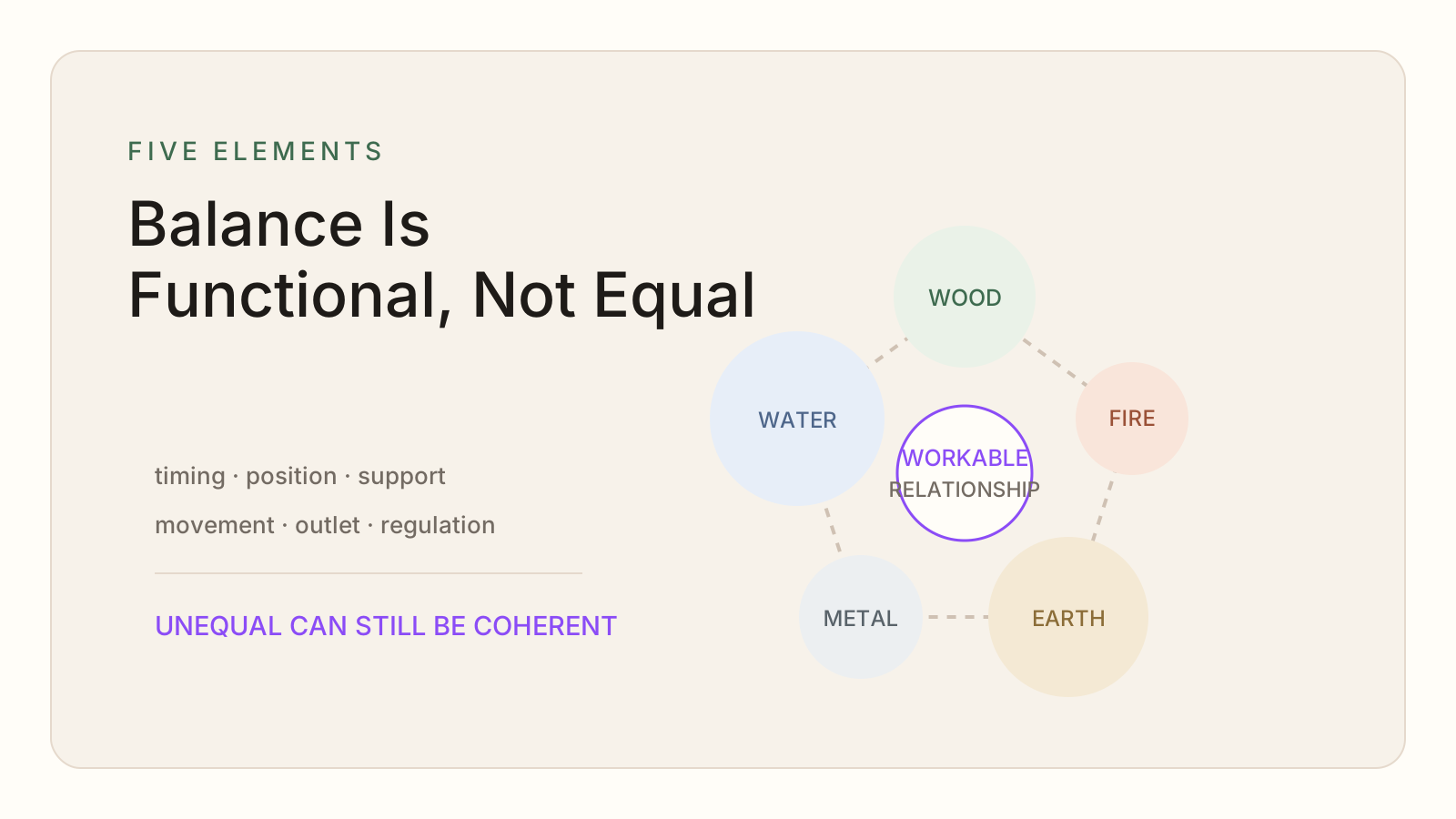
Introduction: Balance Does Not Mean Equal Parts
A Saju chart contains patterns associated with Wood, Fire, Earth, Metal, and Water. When people first see the distribution, a natural response is to count. If one element appears often, it looks excessive. If one does not appear visibly, it looks missing. A chart with equal amounts of all five can seem ideal.
Saju balance is not that simple.
The Five Elements are better understood as phases or functions than as five physical substances. They describe growth, expression, integration, structure, and adaptation. Those functions operate through season, position, and relationship. Equal counts do not guarantee useful movement, and unequal counts do not make a chart defective.
Read The Five Elements in Saju for an introduction to each element. This guide focuses on what balance means once the five are placed back into a complete chart.
Why Counting Is Only a First Observation
Visible counts can help someone notice what is prominent, but every character does not carry identical weight. A stem at the top of a pillar is not read exactly like a branch below. A branch may contain hidden stems, giving it more internal complexity than a simple element label suggests.
Season also changes the working conditions. Wood has natural momentum in spring, Fire in summer, Metal in autumn, and Water in winter. Earth participates strongly in transitions and consolidation. An element that appears once in a supportive season may matter more than several isolated appearances suggest.
Relationships add another layer. One element may generate another, creating movement through the chart. Another may regulate or contain a pattern that would otherwise become difficult to direct. A count cannot show whether those relationships are available, blocked, repeated, or redirected.
This is why element totals are a map legend, not the whole map. How the Four Pillars Work Together explains how season, stems, branches, and position turn a list of symbols into a connected reading.
Balance Means Functional Relationship
In a balanced chart, the important question is whether the elements can perform useful roles in relation to one another. Growth needs expression. Expression needs somewhere to settle. Stability sometimes needs clearer boundaries. Structure needs enough flexibility to avoid becoming rigid. Reflection needs direction so insight can move into action.
This does not require every function to be equally strong at every moment. A project in its early stage may need more Wood-like exploration. A deadline may call for Metal-like decisions. After an intense period of Fire-like visibility, Water-like quiet and Earth-like consolidation may become more useful.
A chart can therefore be uneven yet coherent. One element may act as a clear organizing force while other elements give it outlets, limits, or recovery. The issue is not prominence by itself. The issue is whether the pattern has somewhere constructive to go.
Balance is dynamic. It resembles a conversation among functions, not a still image in which every portion has the same size.
Strong, Sparse, and Absent Elements Need Context
A strong element can describe accessible momentum. Abundant Wood may make development and direction easy to notice. Abundant Metal may make standards and refinement highly available. But the same prominence can become overextension, rigidity, or repetition when the surrounding system offers no counterweight or outlet.
A sparse element does not automatically mean a missing ability. Its function may appear through another part of the chart, through learned behavior, or through the person’s environment. Someone with little visible Fire can still communicate warmly and confidently. The chart does not inventory every skill a person can develop.
Even an element absent from the visible eight characters should be described carefully. Hidden stems may add relevant context, and different traditions may weigh absence differently. Most importantly, “missing” must not become “incapable.” A chart symbol is not a biological deficit or a diagnosis.
The useful question is what role receives less automatic support and how the person currently meets that need. Sometimes the answer is a routine, a relationship, a work structure, or a deliberate practice rather than another symbolic label.
Balance Around the Day Master
Five Element balance is often read in relation to the Day Master. The Day Master’s element gives the chart a center, while other elements can support it, receive its expression, represent what it manages, or apply structure and pressure.
This means the same distribution can carry different implications for different Day Masters. Water may function as support in one chart, expression in another, and a managed resource in another. The element has not changed, but its relationship to the reference point has.
Day Master strength matters here too. A well-supported Day Master may benefit from functions that use or direct its available capacity. A less-supported Day Master may need reinforcement or conditions that reduce unnecessary demand. Neither prescription should be reduced to “add more of your favorite element.”
What Does a Strong or Weak Day Master Mean? explains why strength is a contextual description rather than a grade. What Are the Ten Gods in Saju? introduces the role patterns created by these elemental relationships.
Translating Element Balance into Everyday Observation
The Five Elements become practical when they help describe a repeated situation. Someone may generate ideas easily but struggle to select one direction. Another person may maintain excellent standards but delay sharing work until every detail feels settled. A third may respond well to other people’s needs while overlooking their own limits.
These examples are not diagnoses, and they do not map mechanically to one element count. They are observations that can be explored with elemental language. Growth may need structure. Precision may need expression. Care may need a boundary. Reflection may need a small action.
Useful reflection questions include:
- Which function—growth, expression, integration, structure, or adaptation—feels most available to me?
- Which function becomes excessive when I am under pressure?
- What part of a project or relationship repeatedly loses momentum?
- What small environmental change would give that missing function more support?
The goal is not to manufacture a permanently balanced personality. It is to notice what a particular context needs and expand the choices available within it.
Conclusion: Balance Is Responsive
Five Element balance does not require equal numbers of Wood, Fire, Earth, Metal, and Water. It depends on timing, position, support, regulation, and the ability of different functions to work together.
A chart can highlight familiar momentum and less automatic responses. It cannot declare a person complete or incomplete. Context changes how a pattern is expressed, and deliberate practice can change how someone responds.
To explore your Five Element distribution as a connected pattern rather than a scorecard, Palza offers a reflection-centered approach to Korean Saju.