
Introduction: Roles, Not Fixed Identities
The Ten Gods are among the most useful—and most easily misunderstood—parts of Saju. Their traditional names can sound like characters in a story: Friend, Rob Wealth, Eating God, Hurting Officer, Direct Wealth, Seven Killings, and others. It is tempting to turn each name into a personality type.
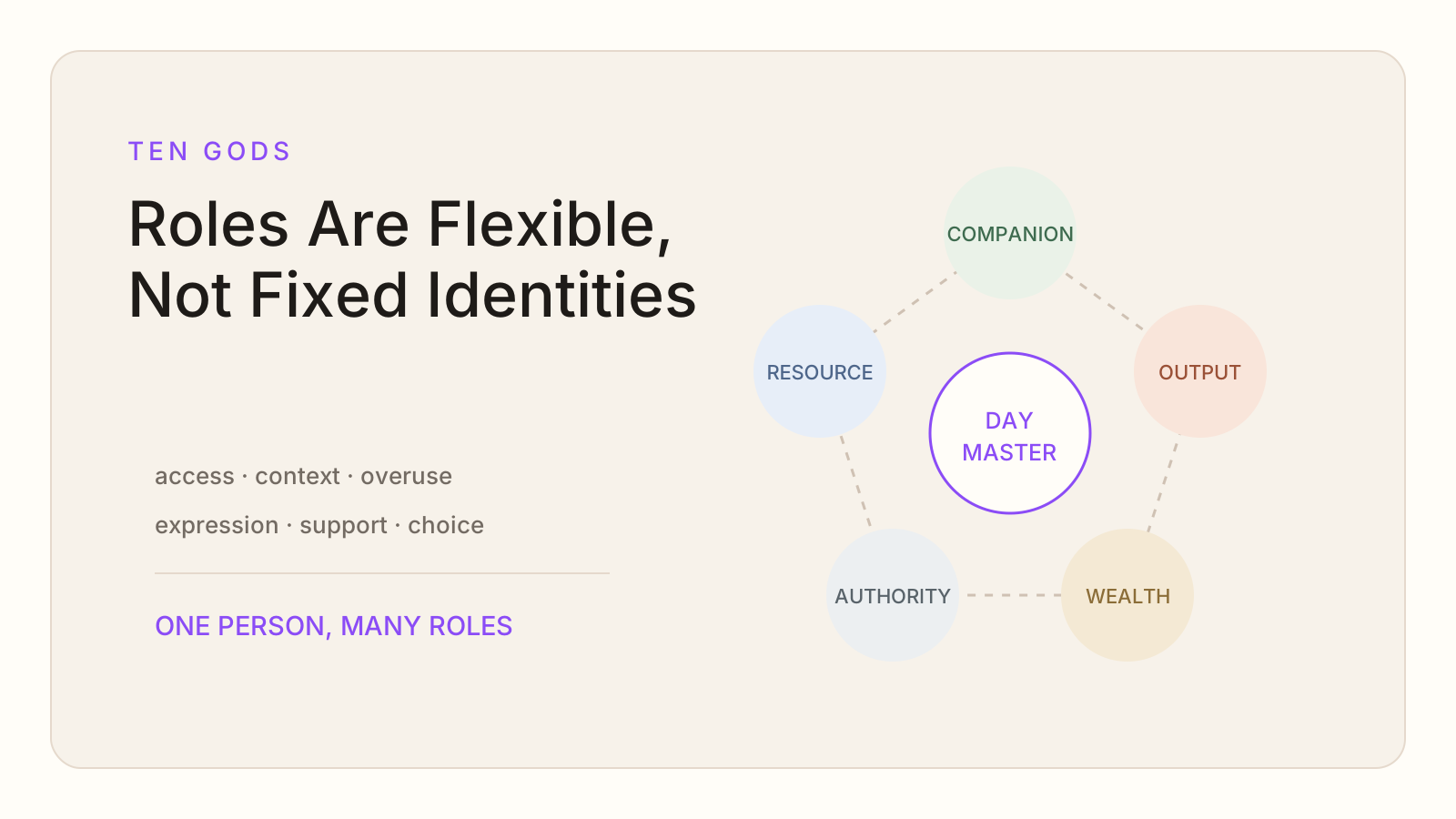
A more useful approach is to read them as role patterns. Each Ten God describes a relationship between the Day Master and another element in the chart. That relationship can become a way of acting: directing yourself, expressing something, managing resources, meeting responsibility, or receiving support.
Roles are flexible. A person may use a strong expression pattern while presenting at work, a Resource pattern while learning a new skill, and an Authority pattern while caring for a shared commitment. No single label contains the whole person.
If these terms are new, begin with the introductory Ten Gods guide. This article takes the next step: how to translate the framework into observable, adjustable behavior.
How Five Relationships Become Ten Gods
The Day Master is the reference point. It is the Heavenly Stem of the Day Pillar, and every other element can be described by how it relates to that point through the Five Element cycles.
Those relationships form five broad families:
- Companion: the same element as the Day Master, associated with peers, self-direction, comparison, and shared space
- Output: the element produced by the Day Master, associated with expression, making, communication, and contribution
- Wealth: the element managed or controlled by the Day Master, associated with resources, priorities, exchange, and practical responsibility
- Authority: the element that regulates the Day Master, associated with structure, standards, duty, limits, and pressure
- Resource: the element that supports or produces the Day Master, associated with learning, care, preparation, protection, and recovery
Each family divides into two patterns according to Yin and Yang polarity, producing the traditional ten. The distinction adds texture—steady versus disruptive expression, formal versus unconventional support, consistent management versus opportunity-seeking—but the family relationship remains the foundation.
The names are shorthand, not moral judgments. “Wealth” does not guarantee money. “Authority” does not guarantee status. “Rob Wealth” does not make someone dishonest. They describe how energy is related and directed within the chart.
A Role Changes with Context
The same pattern can be useful in one situation and strained in another. Companion energy may help someone defend an independent idea, yet make cooperation harder when every suggestion feels like a challenge. Output can make complex knowledge easy to share, yet scatter attention if expression has no audience or limit.
Wealth patterns may support good stewardship: estimating effort, choosing priorities, and turning possibilities into practical results. Under pressure, the same focus can become over-control or the feeling that every relationship must produce something measurable. Authority can create reliability and respect for commitments, but too much pressure can narrow judgment or make rest feel undeserved. Resource can support study and recovery, while overuse may keep a person preparing long after action is possible.
This is why counts alone are incomplete. Position, season, visibility, Five Element balance, and the strength of the Day Master all affect how available or demanding a role feels. A repeated Ten God is not automatically a strength or a problem. It is a theme that deserves context.
Reading Access, Overuse, and Underuse
A practical Ten Gods reading can examine three dimensions of each family.
First, role accessibility describes how naturally the function appears. Someone with clear Output patterns may find it natural to make, explain, or respond. Someone with strong Resource patterns may know how to research, prepare, and seek support.
Second, role overuse shows what happens when a familiar strength repeats too long. Expression can become performance without recovery. Responsibility can become chronic self-monitoring. Companion energy can become comparison. Resource can become endless intake. The risk is often the strength repeated past the point where it remains useful.
Third, role underuse points to functions that receive less automatic attention. A person may have ideas but struggle to share them, accept every expectation without setting a limit, or manage practical demands without making room for learning. A quieter chart pattern does not mean the role is unavailable. People develop skills through experience, relationships, and environment.
The Five Elements help explain the movement underneath these roles. The Ten Gods add a relational focus on what that movement is doing in relation to the person at the center.
A Practical Example: One Project, Five Roles
Imagine a small team preparing a workshop. One person proposes the theme and wants room to shape it independently: Companion. Another turns the idea into slides, exercises, and clear language: Output. Someone defines the budget, schedule, and materials: Wealth. Another checks accessibility requirements and keeps the team accountable to the deadline: Authority. A final teammate gathers research, reviews prior feedback, and makes sure the group has enough support: Resource.
These roles do not need to belong to five different people. One person can move through all of them. The chart may suggest which roles feel immediate and which require deliberate effort, but the situation still matters. A confident presenter may need more Resource time before teaching an unfamiliar topic. A careful planner may need Output space to share a draft before it feels complete.
The example also shows why no family is superior. A project without Output remains an idea. Without Wealth, it may lack workable priorities. Without Authority, important constraints can be ignored. Without Resource, the group may run on empty. Without Companion, ownership and peer contribution may disappear.
The goal is not to maximize every role. It is to notice which one the moment needs and whether the current pattern can shift.
Using Role Patterns for Reflection
Role language becomes valuable when it leads back to lived evidence. Instead of saying “I am an Authority person,” notice when standards help you and when they become pressure. Instead of saying “I lack Output,” ask which setting makes expression easier: conversation, writing, demonstration, or time to prepare.
Try these questions:
- Which role—self-direction, expression, management, responsibility, or support—do I assume first in a group?
- When does that familiar role stop helping and begin to narrow my options?
- Which role do I quietly expect another person to carry for me?
- What is one low-risk way to practice a less familiar role this week?
Ten Gods language should widen observation, not shrink identity. It can also improve relationship conversations when people use it to describe expectations rather than rank one another. Saju Compatibility Without Predictions applies this approach to support, friction, boundaries, and repair between two people.
Conclusion: A Vocabulary for Choice
The Ten Gods translate elemental relationships into roles we can recognize in everyday life. They show how a chart may approach peers, expression, resources, responsibility, and support. Their value comes from holding access and overuse together, then returning the pattern to context.
You are not one Ten God, and no role is a verdict. A familiar pattern can become more skillful; a quieter pattern can be practiced. To explore these relationships as a flexible part of your whole chart, Palza offers a reflection-centered approach to Korean Saju.