
Introduction: From Four Columns to One Chart
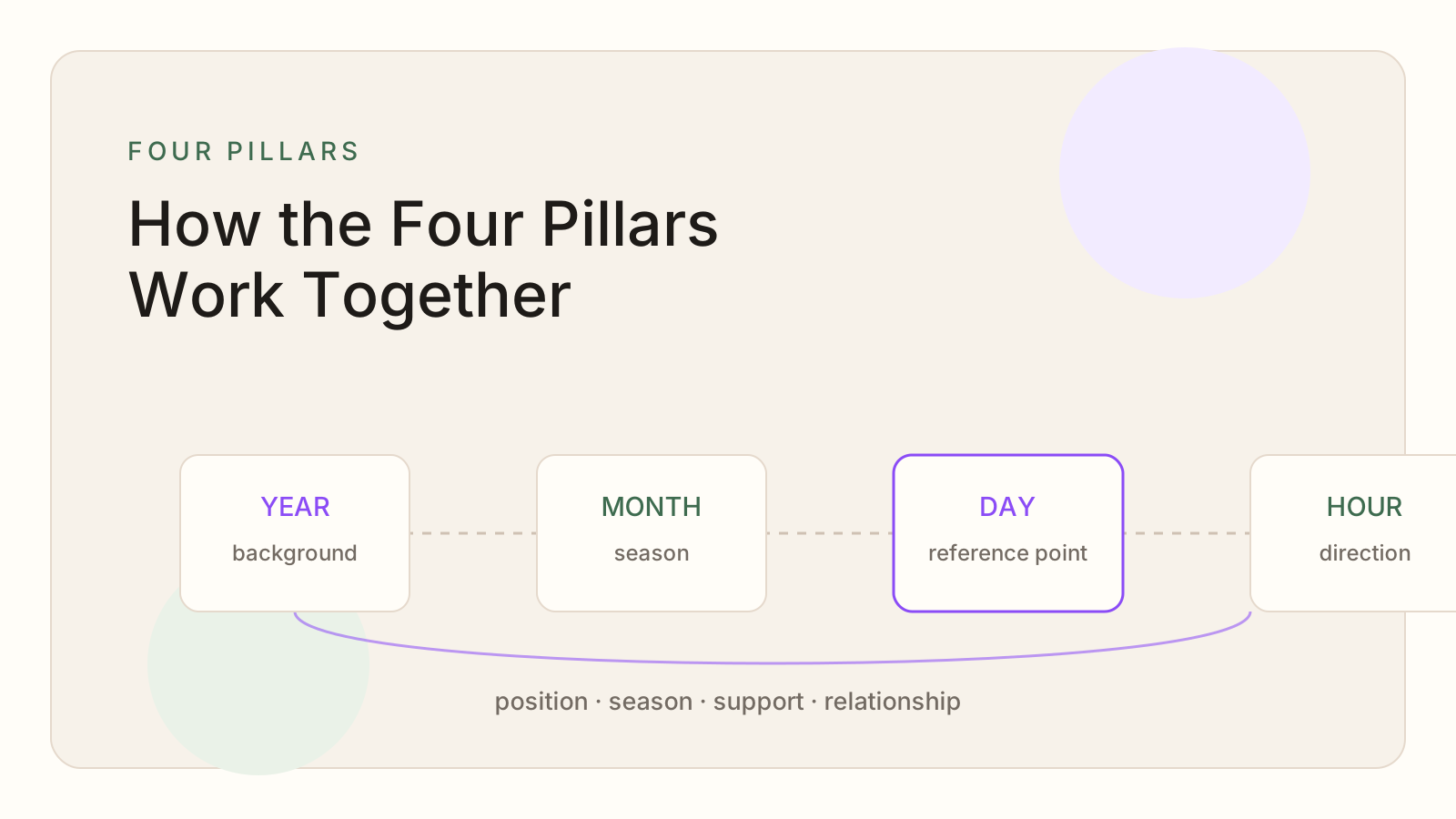
A Saju birth chart is drawn as four pillars: year, month, day, and hour. Beginners often learn these one at a time, which is useful. The year pillar can describe broad background, the month pillar connects strongly to season and operating context, the day pillar contains the Day Master, and the hour pillar adds a more private or long-range layer when birth time is known.
The next step is to stop treating them as four separate boxes.
Each pillar contains a Heavenly Stem above and an Earthly Branch below. Together, the four pillars create eight characters whose meanings change through position, season, and relationship. A symbol that looks prominent alone may become quieter in the full chart. A pattern that appears small may gain support from several other places.
If the basic layout is new to you, start with The Four Pillars Explained and What Is a Saju Birth Chart?. This guide focuses on synthesis: how a reader moves from parts to a whole without turning the chart into a verdict.
The Pillars Are Layers, Not Personality Boxes
Each pillar offers a different vantage point, but those viewpoints overlap. The year pillar may contribute inherited or social context. The month pillar often describes the seasonal field and conditions surrounding daily activity. The day pillar provides the chart’s central reference point. The hour pillar may show private direction, developing interests, or longer-range expression.
These are not four independent personalities living inside one person. Think of them as four camera angles on the same life. One angle may show how someone enters a group, another how they operate under responsibility, and another how they experience themselves in closer settings.
For example, a chart may show a clear, outwardly decisive pattern in a visible position while its day pillar prefers more time to process. That does not create a contradiction that needs to be “fixed.” It may describe a person who can take charge in a role yet needs quiet before making personally important choices.
This layered view is more useful than choosing one pillar as the “real” person. Human behavior changes across relationships and environments. The chart becomes meaningful when it helps name those contextual shifts.
Season Creates the Operating Conditions
The month branch anchors the chart in a seasonal phase. In traditional Four Pillars analysis, season is not decorative background. It changes how much support or momentum different elements may have.
Wood appearing in spring enters different conditions from Wood appearing in autumn. Fire in summer does not operate under the same field as Fire in winter. The element remains recognizable, but its available support, timing, and role within the chart change.
This is why simply counting elements can mislead. Two charts might each show three Wood characters, yet the Wood patterns may function differently because of season, position, and the elements around them. One may have abundant momentum but need clearer limits. Another may need sustained support before its direction becomes visible.
Season does not decide whether a chart is good or bad. It supplies context. Balance in the Five Elements explains why balance means workable relationship and movement rather than equal quantities.
The Day Master Gives the Relationships a Center
The Day Master is the Heavenly Stem at the top of the day pillar. It becomes the reference point for interpreting how other elements relate to the chart’s center.
Without that reference point, the eight characters can look like a collection of disconnected symbols. With it, a reader can ask which patterns support the Day Master, which draw on its energy, which it manages, and which apply structure or pressure. These relationships also form the basis of the Ten Gods framework.
Still, the Day Master is not a shortcut for personality. A Wood Day Master is not automatically adventurous, and a Metal Day Master is not automatically strict. Its polarity, season, roots in the branches, nearby support, and wider chart all affect how the pattern may be expressed.
Read What Is the Day Master in Saju? for the foundation, then What Does a Strong or Weak Day Master Mean? for a contextual account of capacity and support. Strength is one relationship within the system, not a score for the person.
Stems and Branches Create Visible and Rooted Context
The four Heavenly Stems form the chart’s visible upper layer. They often make certain functions easier to notice: expression, support, standards, resources, or initiative. The four Earthly Branches add season, roots, hidden stems, and relationships that may not be obvious from the surface.
This upper-and-lower structure helps explain why isolated labels fail. A visible stem may look unsupported until its roots in the branches are considered. A branch may contain several hidden elemental influences, making it more layered than its main element suggests.
The characters also relate across pillars. Repetition can make a function more available or more demanding. Generating relationships can create flow. Controlling relationships can provide needed structure or produce strain. Traditional combinations and clashes can show places where two directions organize together or pull against one another.
None of these relationships guarantees an event. A clash is not an automatic crisis, and a combination is not an automatic reward. In everyday terms, tension may appear as competing needs, changing conditions, or a repeated demand for adjustment. Support may appear as an environment where a pattern has room to work.
The Heavenly Stems Explained and The Earthly Branches Explained provide the vocabulary for these two layers.
A Practical Sequence for Reading the Whole Chart
A responsible whole-chart reading moves in stages rather than jumping to a dramatic conclusion:
- Confirm the four pillars and note any uncertainty in the birth time.
- Identify the Day Master as the reference point.
- Read the month branch and seasonal conditions.
- Look for roots, visible support, expression, management, and pressure.
- Notice repeated elements and important stem or branch relationships.
- Translate the structure into conditional, observable language.
That last step matters most. “This pattern may prefer time to consolidate before acting” invites observation. “This chart means you cannot handle change” closes the door on context and choice.
A useful reflection question is not “Which pillar controls me?” Try these instead:
- Which part of my behavior changes most between public, working, and private settings?
- What conditions make a familiar strength easier to use well?
- Where do two valid needs pull in different directions?
- What support, boundary, or pause gives the whole system more room to respond?
Conclusion: Relationship Creates Meaning
The Four Pillars work together by giving each symbol a position, a season, a reference point, and a network of relationships. No pillar tells the whole story. The chart becomes readable when those layers are considered together.
Saju can offer language for how patterns gather, support one another, or meet pressure. It cannot remove uncertainty or make choices on someone’s behalf. The most useful reading holds the whole structure in view while leaving room for experience, environment, and change.
To explore the Four Pillars as a connected system rather than a set of labels, Palza translates traditional chart structure into clear language for reflection.