
Introduction: Strength Is Not a Grade
“Is my Day Master strong or weak?” is one of the first questions many people ask after seeing a Saju chart. The words sound like an evaluation. Strong can feel desirable; weak can sound like a flaw.
That is not what the terms mean.
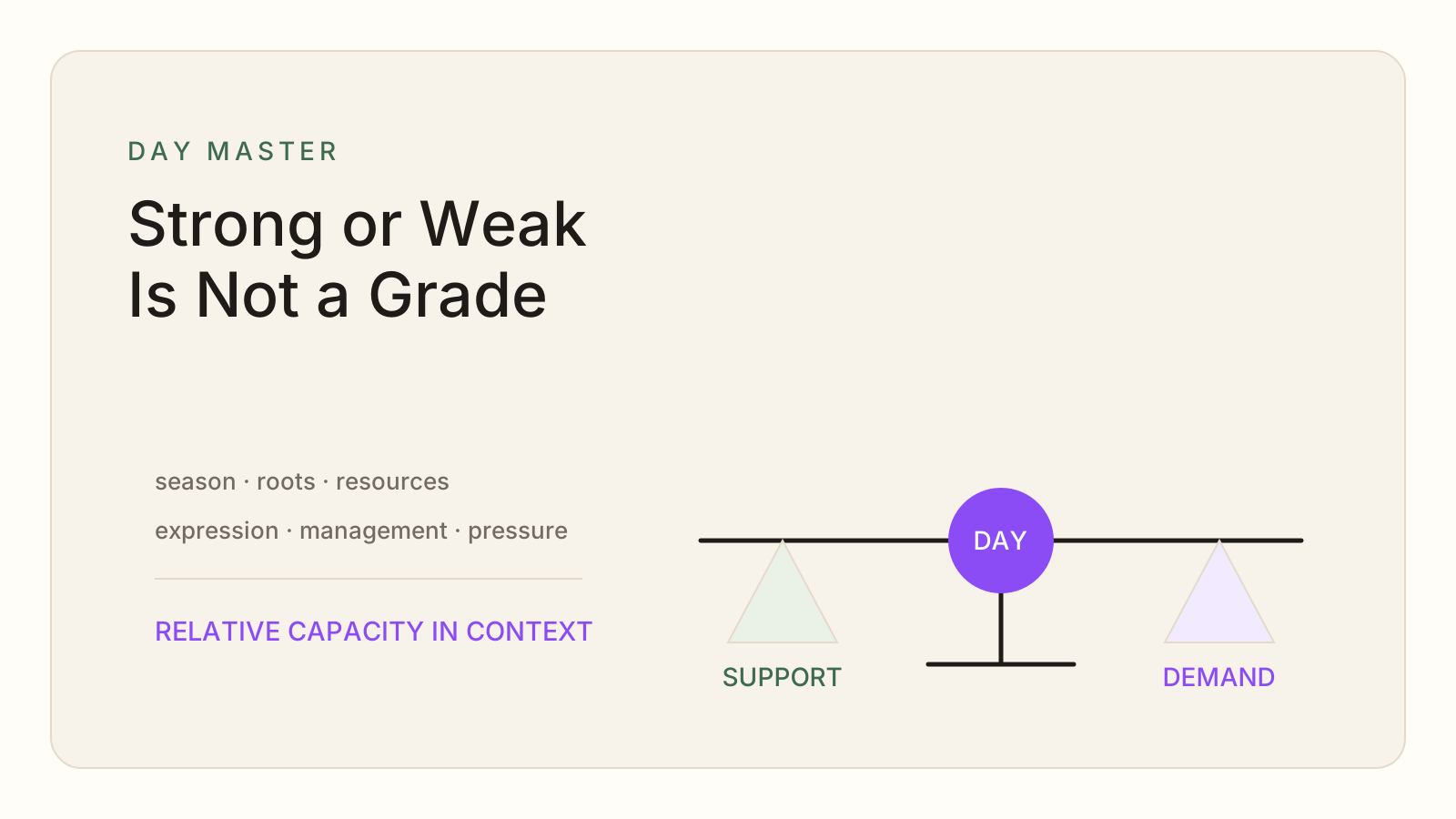
The Day Master is the Heavenly Stem of the day pillar and the central reference point for many chart relationships. Strong and weak describe its relative condition inside the chart: how much seasonal momentum, rooting, and support it has compared with the patterns that express, manage, or regulate its energy.
They do not measure confidence, health, character, intelligence, or the likelihood of success. A strong Day Master is not a stronger person. A weak Day Master is not a weaker person. Start with What Is the Day Master in Saju? if you want the basic role before exploring this additional layer.
Strong and Weak Are Technical Descriptions
Imagine the Day Master as a center working within a system. Some parts of the chart reinforce that center. Others ask it to produce, manage resources, or respond to structure. Strength describes the relationship between available support and those demands.
A relatively strong Day Master often has access to favorable seasonal conditions, roots in the Earthly Branches, or visible support from related elements. A relatively weak Day Master may have less direct support or may be surrounded by more patterns that draw on or regulate its capacity.
The language is relational. A person can be capable, decisive, and resilient while having a technically weak Day Master. Another person can have a strong Day Master and still struggle with flexibility, pacing, or asking for help.
Many charts also sit between obvious extremes. Different reading traditions may weigh particular signals differently, especially around hidden stems, combinations, and specialized chart structures. A careful interpretation should present strength as a working assessment, not unquestionable fact.
How a Reader Assesses Day Master Strength
The first major condition is season. The month branch shows the seasonal field in which the Day Master appears. An element in a supportive season may have more immediate momentum, while the same element in another season may need more help from the rest of the chart.
Next come roots. Earthly Branches can give the Day Master’s element a foothold, including through hidden stems. Roots matter because visible characters do not tell the entire story. A Day Master that looks isolated above may have meaningful support below.
A reader then considers the wider distribution of relationships. Companion and Resource patterns commonly add support. Output, Wealth, and Authority patterns may draw on, occupy, or regulate the Day Master’s capacity. Their meaning depends on proportion and context rather than a simple count.
Distance and position can matter too. Nearby support may operate differently from a remote signal. Repetition may strengthen a function, while combinations may redirect how an element behaves. This is why How the Four Pillars Work Together treats the chart as a connected system.
A Strong Day Master Is Not Automatically Easier
Relative strength can provide capacity. Someone may find it natural to hold a position, sustain effort, initiate action, or meet external demands. When the chart and environment give that capacity a useful outlet, it can feel steady and effective.
Capacity can also become accumulation. A pattern with abundant support may have difficulty releasing control, receiving feedback, or changing pace. More reinforcement is not always the answer. Expression, responsibility, boundaries, or purposeful challenge may help the available energy move.
Consider a work setting. A person with a strongly supported center might remain composed while others hesitate, making them useful during uncertainty. In another context, the same self-reliance could lead them to decide too quickly or carry work that should be shared.
The useful interpretation is not “strong means leadership.” It is “this pattern may have accessible internal momentum; how is that momentum being directed?” Context changes whether a capacity becomes support or strain.
A Weak Day Master Is Not Broken
A relatively weak Day Master may be more sensitive to conditions, support, timing, or the demands around it. That sensitivity is not failure. It can contribute to responsiveness, collaboration, careful preparation, or awareness of limits.
The difficulty appears when demands consistently exceed available support. A person may overextend, absorb too many expectations, or have trouble protecting time for recovery and consolidation. The response is not to imitate a stereotypically “strong” person. It is to understand which environments, relationships, and routines make capacity more available.
For example, someone may do excellent work with clear priorities and reliable collaboration but become scattered when every request arrives as equally urgent. The chart language may help name the difference between lack of ability and lack of supportive conditions.
This framing preserves agency. It directs attention toward resources and choices rather than making weakness into an identity. The Five Elements in Saju offers practical language for the functions that may support, express, or regulate a pattern.
Using Strength as a Reflection Tool
Strength assessment is useful when it improves the next question. Instead of asking whether strong or weak is better, consider:
- When do I have more capacity than the situation requires, and where could I redirect it?
- Which kinds of demand consistently use more energy than I expect?
- What forms of support help me act with clarity rather than dependence?
- Where would expression, structure, collaboration, or rest create better movement?
The answer may differ across work, relationships, and creative projects. A familiar pattern can function differently when responsibilities, resources, or social expectations change.
Balance in the Five Elements develops this idea further. Balance is not a perfectly equal chart. It is the ability of the system to distribute support and demand in a workable way.
Conclusion: Capacity Exists in Context
Strong and weak Day Master language describes relative capacity inside a chart. Season, roots, visible support, and surrounding relationships all contribute to the assessment. No single count or label is enough.
Used responsibly, strength can reveal where momentum is readily available and where support matters more. It cannot determine a person’s worth or future. A chart may suggest a pattern; lived context and conscious choices shape how that pattern is expressed.
For a contextual reading that keeps the Day Master connected to the whole chart, Palza offers modern Saju language designed for self-understanding rather than ranking.