
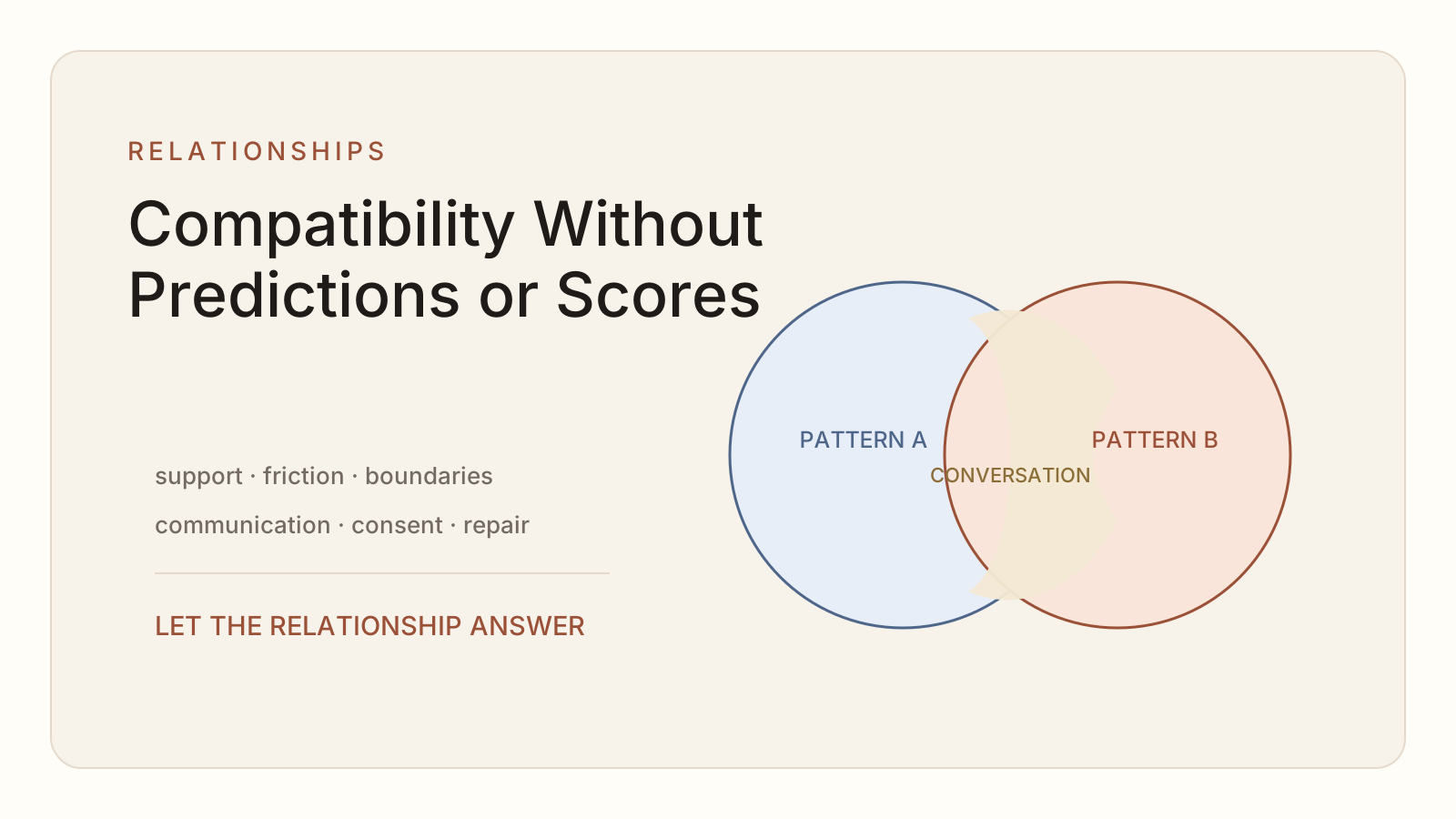
Introduction: Compatibility Is Not a Forecast
People often bring a high-stakes concern to Saju compatibility: whether a relationship will work. A score, a lucky pairing, or a warning can feel reassuring because it turns uncertainty into a simple answer.
But a chart cannot observe whether two people listen, keep agreements, respect a boundary, tell the truth, or repair harm. Those behaviors shape a relationship far more directly than a symbolic match. Compatibility language becomes risky when it predicts marriage, separation, loyalty, or a guaranteed future.
A safer use of Saju is to form reflection questions, not verdicts. Comparing charts may suggest where two people have similar rhythms, where their needs differ, and which situations deserve clearer conversation. The comparison remains a hypothesis until both people recognize it in lived experience.
Saju and Relationship Patterns introduces compatibility as a language for communication. This guide focuses on how to use that language without surrendering judgment or agency.
Compare Whole Patterns, Not One Sign
Compatibility is sometimes reduced to zodiac animals or a single element relationship. A complete Saju chart is more layered. The four pillars include stems, branches, season, the Day Master, Five Element movement, and role relationships. How the Four Pillars Work Together explains why no character should carry the entire interpretation.
When two charts are compared, several observations can sit beside one another:
- Their relative pace: similar movement, or a contrast between initiation and processing
- Functions one person finds familiar that the other finds less automatic
- Roles both people compete to hold or responsibilities both tend to avoid
- The interaction among their expression, structure, resource, and recovery patterns
These are not scores. A similarity can create ease, but it can also amplify a shared blind spot. A difference can create friction, but it can also make the relationship more adaptable. Context decides whether a contrast becomes support, tension, or simply a neutral difference.
Support and Friction Are Both Information
Support appears when one person’s way of moving makes another person’s needs easier to meet. A person who enjoys giving ideas structure may work well with someone who generates possibilities quickly. Someone who pauses before responding may help a fast-moving partner notice details. Shared values or compatible recovery rhythms can make coordination feel natural.
Friction appears where patterns make different requests at the same time. One person may want to resolve conflict immediately while the other needs quiet before speaking. Both may prefer to lead, or both may wait for the other to define a plan. One may read careful questions as care; the other may experience them as control.
Neither category predicts success. Easy support can be taken for granted. Repeated friction can become skillful when it is named early and handled with respect. It can also become harmful when someone uses the chart to excuse behavior: “That is just my element” is not a substitute for accountability.
Balance in the Five Elements offers a useful principle here: balance is a functional relationship, not equal quantities. Two people do not need identical patterns. They need workable ways to respond to difference.
Communication, Boundaries, and Repair
A responsible compatibility reading should return symbolic language to observable behavior.
For communication, observe pace, directness, and processing. One person may think aloud while the other speaks after reflection. Their signals of overload and preferred way to reopen a paused topic are practical parts of the comparison.
For boundaries, observe how closeness and autonomy are negotiated. One person may assume responsibility without asking, while another may need advance notice before plans change. A chart may offer language for these tendencies, but consent must come from the people involved. No reading grants access to another person’s time, body, money, or private information.
For repair, focus on what happens after friction. Useful evidence includes each person naming their contribution without turning the chart into blame, making a specific request, agreeing on a different action, and noticing whether the pattern changes. Compatibility is less about avoiding every conflict than about whether repair is possible and mutual.
This is also why Saju Is Not Fortune Telling matters. A symbolic framework should support judgment, not replace it—especially in decisions involving safety, trust, or major commitments.
A Paired Example Without a Score
Imagine Mina tends to organize uncertainty by making a plan. Clear roles and timelines help her relax. Theo tends to understand a situation by talking through several possibilities before choosing one. His first idea is often exploratory rather than a promise.
A score might label this mismatch as good or bad. A pattern-based reading notices a loop. When Theo explores aloud, Mina may hear instability and add more structure. When Mina makes the structure firmer, Theo may feel rushed and generate more alternatives. Each response increases the condition that unsettles the other.
The same difference can become useful with a small agreement. Theo can mark whether he is brainstorming or proposing a decision. Mina can wait until the end of a defined exploration period before building the plan. Her structure then gives ideas a path forward; his exploration keeps the plan from closing too early.
This example does not prove that every similar pair will behave the same way. Family history, culture, stress, relationship type, and learned skills all matter. The Saju language simply helps name a possible interaction so the pair can test it together.
The Ten Gods as Role Patterns offers another lens for this example: expression and authority are roles that can cooperate instead of competing for control.
A Safer Compatibility Conversation
Before comparing charts, both people should know how the information will be used. A reading about someone who has not consented should not become a hidden assessment of their character. Keep conclusions provisional, protect birth information, and let lived evidence outrank the interpretation.
Useful reflection questions include:
- Where does our relationship already make daily life easier for both of us?
- Which repeated friction is really a difference in pace, role, or communication need?
- What boundary or agreement would make that difference safer to navigate?
- After conflict, what kind of repair helps each of us rebuild trust?
Answers may change over time. A work partnership, friendship, family relationship, and romance place different demands on the same two charts. Even within one relationship, stress and life stage change what support is available.
Conclusion: Let the Relationship Answer
Saju compatibility can offer a vocabulary for similarities, contrasts, support, and friction. It cannot decide whether two people belong together or promise what they will do next.
The most responsible reading ends by returning authority to the relationship itself: what the people communicate, consent to, practice, and repair. If you want a chart comparison designed to open that kind of conversation rather than close it with a score, Palza offers a reflection-centered approach.