
Introduction: Two Modes, One System
Yin and Yang are among the most familiar ideas in East Asian thought, but they are also easy to flatten into opposites: dark versus light, passive versus active, soft versus strong. In Korean Saju, the idea is more useful and more subtle. Yin and Yang describe two complementary modes through which energy can move, gather, express, and change.
Neither mode is better. Neither is a complete personality type. A person can be direct in one setting and receptive in another, outwardly active at work and inwardly reflective after conflict. Saju uses Yin and Yang to notice these differences in expression, then reads them alongside element, season, and position in the chart.
If this is your first encounter with the system, begin with What Is Korean Saju?. The key idea is that Saju offers a language for reflection, not a verdict about who someone must be.
Yin and Yang Are Relational
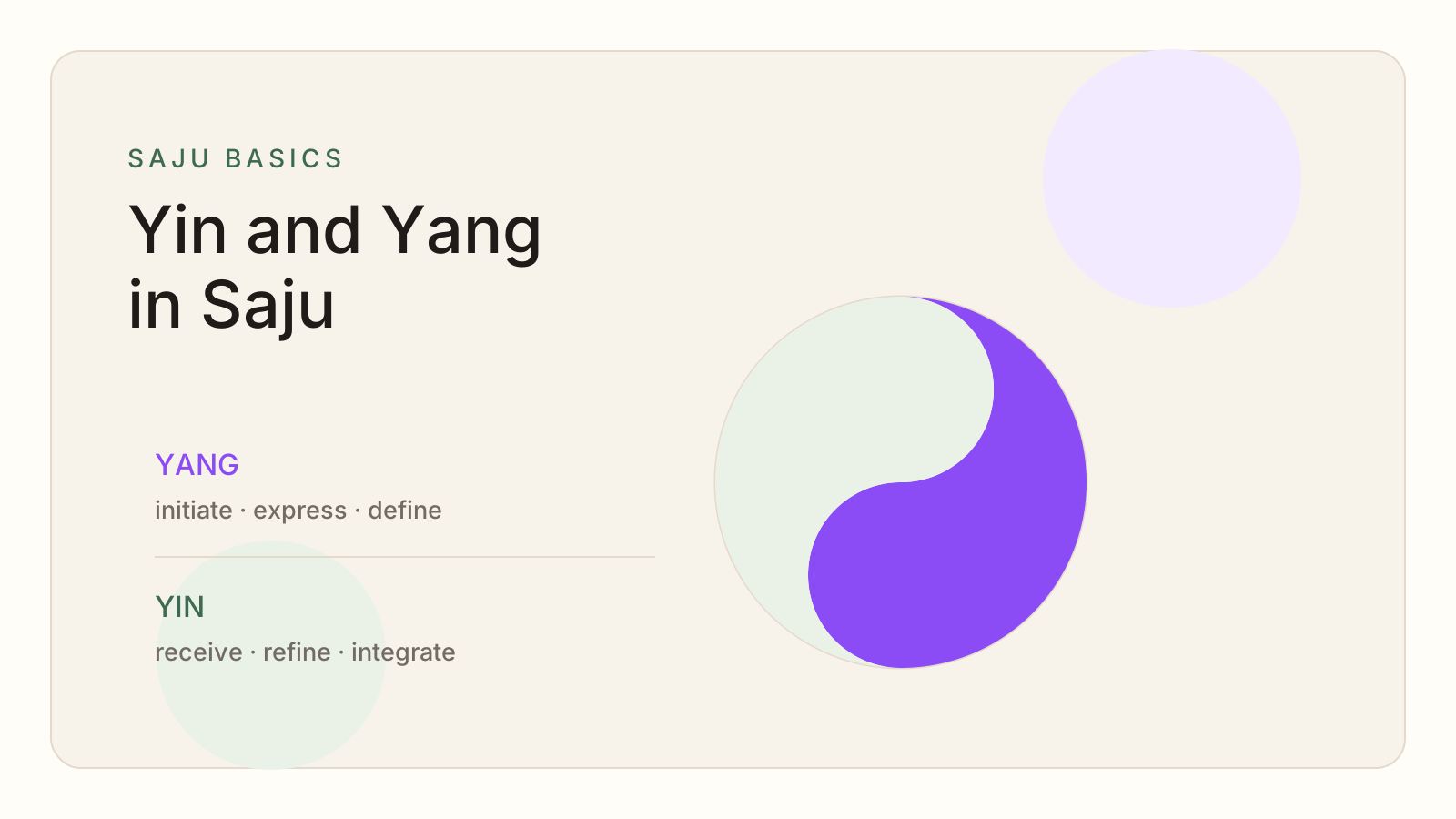
Yang is often associated with outward movement, visibility, initiative, expansion, and clearer edges. Yin is often associated with inward movement, receptivity, concentration, responsiveness, and finer adjustment. These are tendencies in movement, not moral values.
Consider a conversation. A Yang mode might appear as naming the issue early, proposing a direction, or moving the group toward a decision. A Yin mode might appear as noticing a change in tone, waiting for more information, or refining an idea before speaking. Both can serve the conversation. Either can also become unhelpful when overused: initiative can become force, while receptivity can become avoidance.
The same person may move between the two. Context changes which response is available or useful. This is why Yin and Yang should not be reduced to introvert and extrovert, female and male, or weak and strong. Those shortcuts erase the relational quality of the concept.
A practical question is not “Am I Yin or Yang?” but “Which mode am I using here, and what might the situation need next?”
How Polarity Appears in a Saju Chart
Each of the eight characters in a complete Saju birth chart has a Yin or Yang polarity. Every pillar contains an upper character called a Heavenly Stem and a lower character called an Earthly Branch. The sequence alternates between Yang and Yin, creating a patterned structure rather than a random label.
The Four Pillars Explained introduces the year, month, day, and hour layers. Within those layers, polarity adds information about how an element may express itself. A Yang sign often suggests a more visible or initiating form of that element; a Yin sign often suggests a more concentrated or responsive form.
The Day Master’s polarity is especially noticeable because the Day Master acts as the chart’s reference point. Still, it is only one piece. What Is the Day Master in Saju? explains why the rest of the chart can support, redirect, or complicate that central pattern.
Counting Yin and Yang characters can be a useful first observation, but it is not a complete interpretation. Position matters. Season matters. The relationships among the characters matter. A chart that looks strongly Yang on paper may be expressed with restraint because of its wider structure or the person’s lived environment.
Each Element Has a Yin and a Yang Form
The Five Elements are not divided into “Yin elements” and “Yang elements.” Each element has both expressions. The ten Heavenly Stems make this especially clear:
- Yang Wood and Yin Wood both concern growth and direction, but one may appear more initiating while the other works through adjustment and connection.
- Yang Fire and Yin Fire both concern expression and warmth, with different scales and rhythms of visibility.
- Yang Earth and Yin Earth both concern stability and integration, expressed through different forms of holding and organizing.
- Yang Metal and Yin Metal both concern structure and discernment, with different ways of defining or refining.
- Yang Water and Yin Water both concern movement and information, expressed through different kinds of flow and depth.
These descriptions are starting metaphors, not personality sentences. The article on the Five Elements in Saju explains the functions behind Wood, Fire, Earth, Metal, and Water. The Heavenly Stems Explained then shows how polarity creates ten distinct stem patterns.
In everyday life, two people may share a strong Metal emphasis yet handle standards differently. One may establish a clear rule and apply it consistently. Another may edit, compare, and refine until the standard feels precise. The common element helps name the function; Yin and Yang help describe its mode.
Balance Is Movement, Not a Perfect Split
It is tempting to treat a balanced chart as one with four Yin and four Yang characters. Saju is not that mechanical. Balance depends on whether a pattern can move, respond, rest, and change with its conditions.
Imagine someone whose default is visible action. That quality may be valuable in a slow-moving team that needs a starting point. In a tense conversation, however, the same person may benefit from pausing long enough to receive information. The goal is not to suppress a Yang tendency. It is to give that tendency a wider range.
The reverse is also true. Someone skilled at observation and careful response may notice what others miss. When a situation needs a timely boundary, that person may need to make the insight more explicit. Yin does not need to become Yang permanently; it can support a Yang action when the context calls for one.
This dynamic view prevents Saju from becoming a scorecard. A chart does not award points for one polarity or diagnose a deficit in the other. It can suggest where a person has familiar momentum and where a less familiar mode may expand their choices.
Reflection Questions for Everyday Patterns
You do not need to decide which polarity “wins” in your chart. Start with observation:
- When do I naturally initiate, make visible, or define—and when does that help?
- Where do I prefer to receive, refine, or wait for context—and what does that allow me to notice?
- Under stress, does my familiar mode become too forceful, too diffuse, too fast, or too withdrawn?
- What small shift toward the complementary mode would give me another option?
Answers may change across work, relationships, creativity, and rest. That variation is useful data. It shows that a pattern is being expressed through a real life, not acting as a fixed label.
Conclusion: Polarity Expands Choice
Yin and Yang give Saju a vocabulary for complementary movement. They can help distinguish initiating from receiving, broad expression from fine adjustment, and visible action from inward consolidation. But they do not divide people into permanent camps.
The most constructive reading asks how both modes participate in a life. Your familiar polarity may show where action feels natural; its complement may reveal another way to respond. Context changes how a pattern is expressed, and awareness can widen the response you choose.
If you would like to explore your chart through this kind of non-deterministic reflection, Palza translates traditional Saju patterns into clear, modern language.