
Introduction: The Upper Character of Each Pillar
Look at a Korean Saju chart and it displays four pairs of characters. The upper character in each pair is a Heavenly Stem. With four pillars—year, month, day, and hour—a complete chart contains four visible stems.
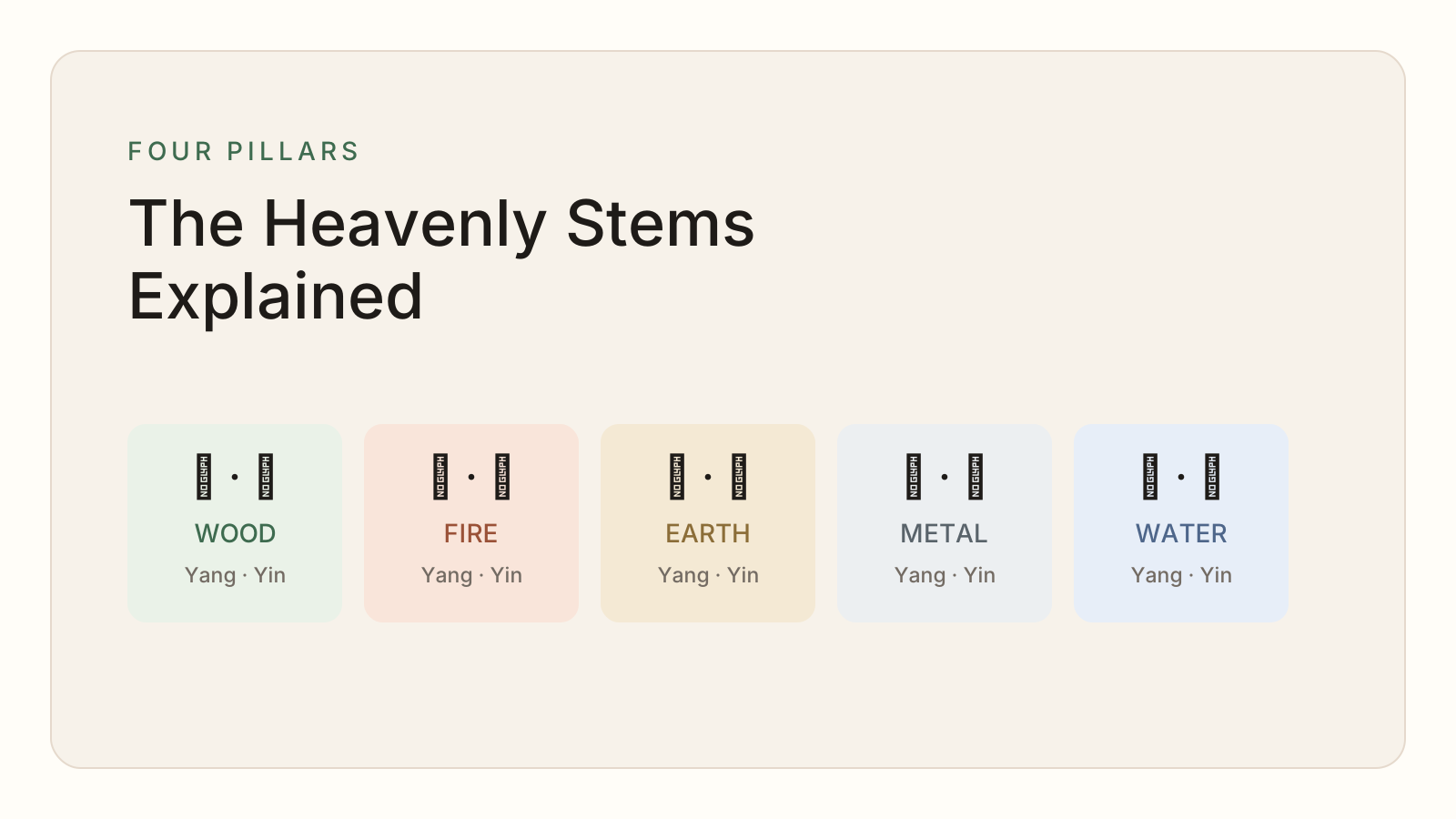
There are ten Heavenly Stems in the traditional cycle. Each combines one of the Five Elements with either Yang or Yin polarity. This produces two forms of Wood, two of Fire, two of Earth, two of Metal, and two of Water.
The word “heavenly” can sound mystical in English. In practice, stems are part of a precise symbolic vocabulary. They help a reader describe how an element is expressed in a particular position and how it relates to the rest of the chart. For the wider structure, see The Four Pillars Explained and What Is a Saju Birth Chart?.
The Ten Stems at a Glance
The stems follow a fixed order, alternating Yang and Yin:
- 甲 Jia — Yang Wood: upright growth and direction
- 乙 Yi — Yin Wood: flexible growth and connection
- 丙 Bing — Yang Fire: broad visibility and momentum
- 丁 Ding — Yin Fire: focused warmth and illumination
- 戊 Wu — Yang Earth: large-scale stability and containment
- 己 Ji — Yin Earth: cultivation and careful integration
- 庚 Geng — Yang Metal: decisive structure and definition
- 辛 Xin — Yin Metal: precision, refinement, and discernment
- 壬 Ren — Yang Water: wide movement and active flow
- 癸 Gui — Yin Water: subtle circulation and accumulated depth
Romanization varies across Chinese, Korean, and English-language sources. The characters are the stable reference. Palza uses the common English forms above when helpful, while keeping attention on the underlying element and polarity.
The images in the last column are memory aids, not literal identities. Jia is not always a tree, and a person with a Ding Day Master is not always a candle. Metaphors become useful only when they lead back to observable patterns and remain open to context.
Five Element Pairs, Not Ten Isolated Types
Learning the stems as five pairs makes the system easier to understand. Each pair shares an elemental function while differing in mode.
Wood concerns development, direction, and the ability to extend. Jia, the Yang form, can provide a starting image of growth that establishes a line. Yi, the Yin form, can suggest growth that finds openings and adjusts through relationship.
Fire concerns expression, warmth, and making something perceptible. Bing often evokes broad radiance or visible momentum. Ding suggests focused attention, detail, or warmth held close enough to guide.
Earth concerns holding, mediating, and integrating. Wu can point toward broad containment or a stable center. Ji can suggest cultivation: sorting, tending, and bringing separate materials into workable form.
Metal concerns standards, boundaries, and discernment. Geng may express through a clear cut or decisive structure. Xin may work through calibration, editing, and a precise sense of what fits.
Water concerns movement, information, and adaptive depth. Ren can suggest a wide current that connects distant points. Gui can suggest subtle circulation, sensitivity to conditions, or knowledge gathered over time.
These are not rankings. Yang is not more powerful than Yin, and no element is more desirable than another. Yin and Yang in Saju explains why polarity describes complementary modes rather than fixed personality camps. The guide to the Five Elements in Saju gives more context for the shared functions within each pair.
Why the Day Stem Is Called the Day Master
One Heavenly Stem receives special attention: the stem at the top of the day pillar. It is called the Day Master because it becomes the reference point for many relationships in the chart.
If the day stem is Jia, for example, the reading begins with Yang Wood as a center of reference. Other stems and branches are then considered by how they support, express, regulate, or interact with that center. This relationship-based method also helps derive the Ten Gods, a separate framework for naming role patterns.
The Day Master does not replace the whole chart. A stem’s element and polarity offer a useful starting vocabulary, but season can strengthen or redirect its expression. The branches below the stems add context. Repeated elements, combinations, and the chart’s overall distribution all matter.
That is why the Day Master guide avoids sentences such as “Jia people are always decisive” or “Gui people are always private.” A responsible interpretation uses conditional language: a pattern may suggest a familiar way of moving, especially when the rest of the chart supports it.
Reading Stems in Position and Relationship
The same stem can carry different emphasis depending on where it appears. The year stem sits in a broad social and inherited layer. The month stem participates in the seasonal and operating context. The day stem provides the Day Master. The hour stem can add detail about private direction or long-range development when birth time is known.
Stems also interact. A chart reader may notice repetition, support among elements, regulation, or traditional stem combinations. None of those signals should be translated into a guaranteed event. They describe structure and relationship inside the chart.
For example, repeated Metal stems might make standards, evaluation, or refinement especially visible. In one environment, that could support clear quality control. In another, it could become exhausting perfectionism. The useful question is not whether Metal is “good.” It is how the pattern is functioning and what helps it stay flexible.
The lower characters, called Earthly Branches, add season, time, and layered elemental context. Read The Earthly Branches Explained next to see why a stem never operates alone.
Reflection Questions for a Stem Pattern
When exploring a visible stem—especially your Day Master—try questions that keep interpretation grounded:
- Where does this elemental function already appear in my choices or habits?
- Does its Yang or Yin mode change across public and private settings?
- What conditions help this pattern become useful rather than excessive?
- Which parts of the chart or my environment offer a complementary response?
These questions turn symbolic language into observation. They also leave room for learning, culture, responsibilities, and personal history to shape how a pattern is lived.
Conclusion: A Starting Vocabulary, Not a Verdict
The ten Heavenly Stems form a compact system: five elements, each expressed through Yang and Yin. They make the upper layer of every pillar readable and give the Day Master its basic identity. Their elegance lies in combination, not in ten standalone character profiles.
A stem can name a tendency toward growth, expression, integration, structure, or adaptation. It cannot decide a person’s career, relationships, or future. The chart adds context, and lived experience adds more. Used carefully, the stems help someone notice patterns and consider a wider range of choices.
To see your own stems translated as part of a complete chart rather than isolated labels, Palza offers a modern, reflection-centered Saju experience.